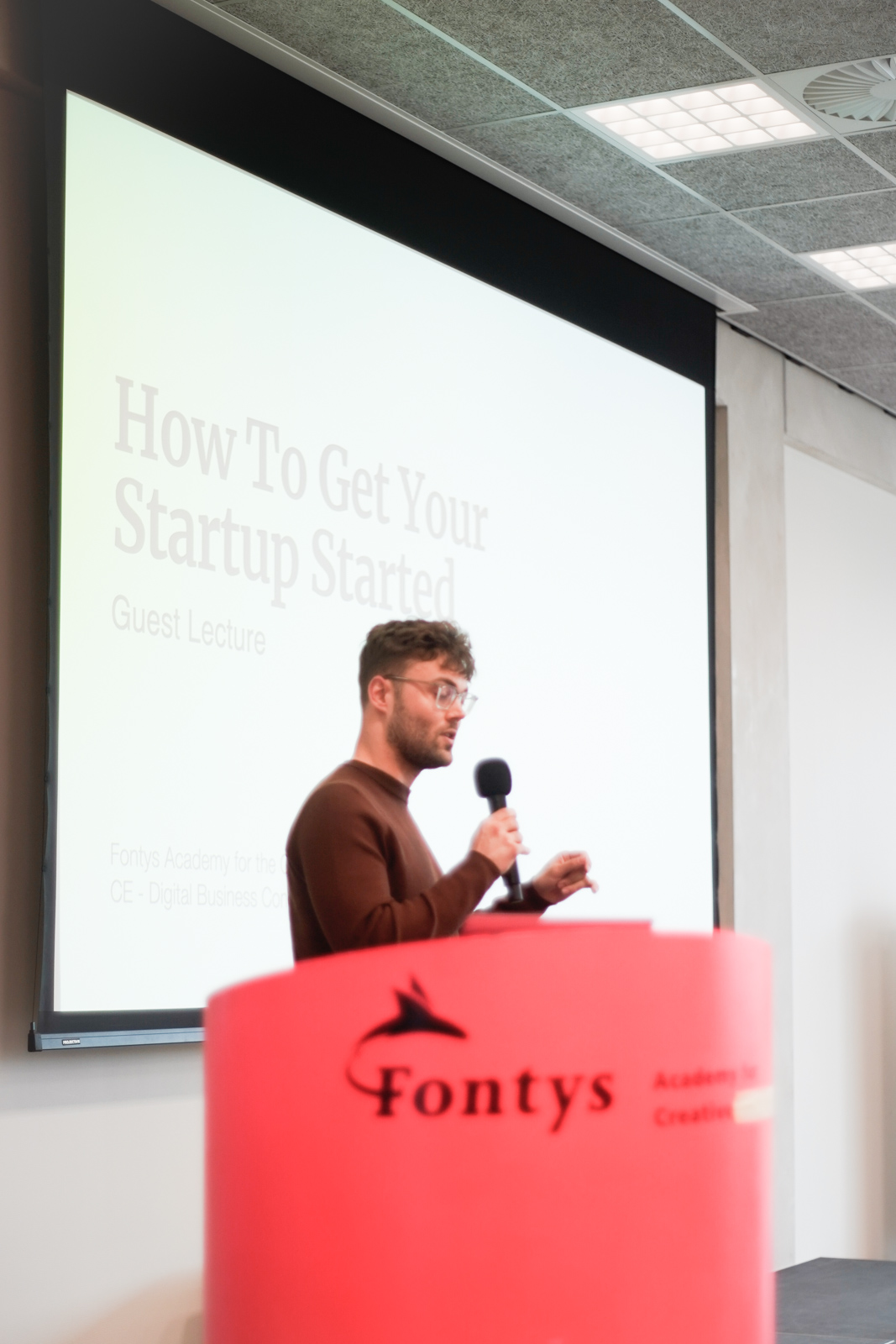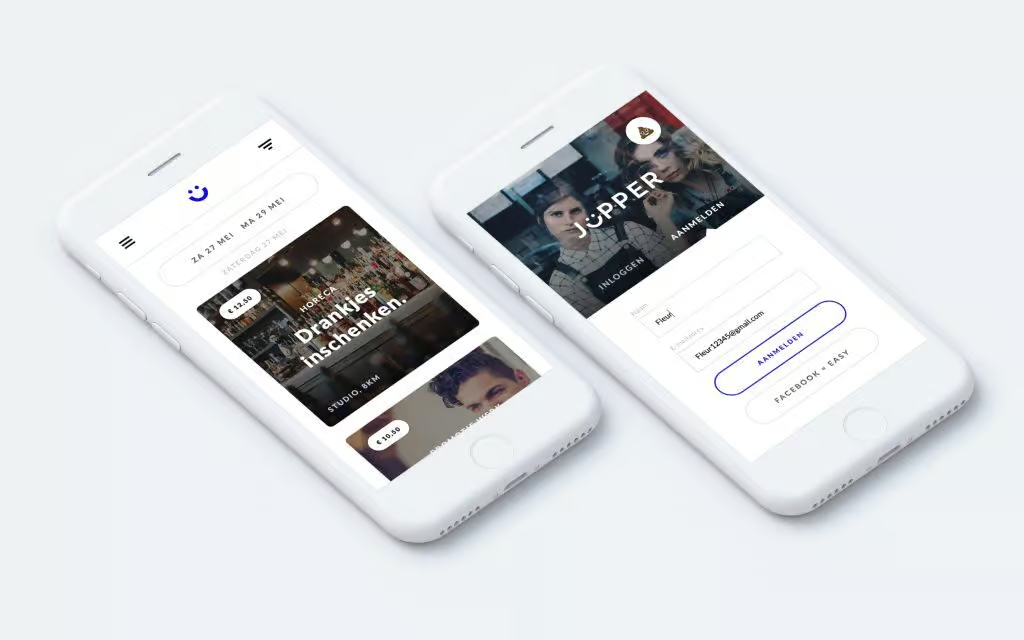
In the second year of the Digital Business Concepts program, I spent the entire academic year working on a start-up called Jopper together with four classmates, under the guidance of our school. At the end of the school year, there was an opportunity to continue the start-up through a summer program at Blue Whale Ventures. Together with two classmates, I successfully completed this summer program, also known as the PreXLR program. This blog article contains a reflection on myself and the most important learning moments from this period.
At the beginning, I did not know exactly what to expect from the PreXLR program at Blue Whale Ventures, but their website already mentioned that it would be an intensive program with close guidance. After our first meeting, it became clear that this would be a highly educational trajectory, but certainly not an easy one.
During the first meeting, I immediately learned that many start-ups fail due to premature scaling: they start expanding their business too early, before it has been sufficiently validated whether what they are building actually matches the needs of their target audience. During courses at school, I had already learned about the Build-Measure-Learn method, which helps you create a Minimum Viable Product (MVP) to avoid spending too much time building something that the target audience does not want.
At Blue Whale Ventures, however, we were taught that there are many alternative ways to test your product cheaply with your target audience. They taught me that interviews are powerful experiments for learning more about the needs of your audience. Interviews only cost time—not money—and they help you understand why your target audience behaves in a certain way. Sometimes the audience exhibits behavior they themselves do not find desirable. In such cases, it is possible to design a suitable solution and attach a revenue model to it, ultimately creating a successful business.
During the first meeting, I also learned that vision is the foundation of a start-up. Vision was often discussed at school, but I did not realize how crucial it is for entrepreneurship. I learned that a vision explains why you do certain things. If you truly believe in your vision, it gives you a clear goal on the horizon to work toward. It provides direction when deciding on next steps. I realized that a strong vision explains why some start-ups are able to raise funding from investors even without a finished product or proven market demand. Without a vision, a project team can quickly fall apart, because the plans of your initial idea often change while experimenting with your business model.
I also discovered during the first meeting that gut feelings add little value to a start-up. You can use them as motivation, but they offer no real value unless they are validated. I used to think that a good idea could take you far, but now I know that your target audience is rarely waiting for your first idea.
By continuously engaging in conversations with your target audience, you uncover what their real problem is and how they envision a solution. During these conversations, it is important not only to listen to their words, but also to pay attention to facial expressions and intonation, which can reveal a lot about how they truly feel. Writing a business plan and expecting reality to follow it exactly makes little sense. In practice, things will be different. That is why I learned to start experimenting from day one to prevent disappointment. This is an ongoing process that essentially never ends.
The day after the first meeting, we immediately went out onto the streets to test whether the assumptions behind our concept were actually correct. We assumed that students struggled to combine school and work and therefore needed a more flexible part-time job. In our concept, students could decide for themselves where and when they wanted to work. The very first experiment already showed that students do not find it difficult to combine school and work at all. This was a direct blow, but it clearly demonstrated the importance of talking to your target audience.
After conducting our first interviews, we quickly realized that more preparation was needed to conduct effective interviews. I learned that good listening skills, combined with asking the right questions, allow you to learn the most about your target audience. I still find this difficult, and there is definitely room for improvement here.
After the first meeting, Blue Whale Ventures intentionally did not give us an Excel sheet to document our experiments. This was done to show us that proper preparation is essential when conducting interviews. After the second meeting, we received more interview tips and were given an Excel sheet—the so-called experiment design sheet. This document helps ensure you are well prepared for interviews and that results are recorded correctly. I learned that an experiment design sheet is essential both for interview preparation and for properly documenting outcomes.
After the second meeting, I paid more attention to my interview technique. For example, by asking questions such as “So… you found this itch annoying?” or “So… you didn’t experience this as a problem?”, you can confirm that you have correctly understood the interviewee. This is important, because you are naturally inclined to interpret answers in your own way. Repeating what someone says helps prevent drawing incorrect conclusions. In early interviews, I often asked questions like “What does your ideal part-time job look like?”, which usually resulted in vague and unhelpful answers. By asking about past behavior, you often learn much more about your target audience.
The results of the experiments had to be presented twice a week to Blue Whale Ventures and the other teams participating in the program. They provided feedback on our process and advice on how to move forward. Presenting was the part of the program I enjoyed the least, and I still find it difficult. I am very critical of myself and have high expectations when it comes to presenting. As a result, I build up extra tension, which only makes presenting more difficult. Even though I presented to a small group, I noticed that presenting still creates pressure that does not diminish, despite extensive practice.
Although presenting was challenging for me, I was able to gain energy from other activities. One of my most valuable contributions to the group was conducting interviews with owners of hospitality businesses. I usually led the conversation, while one of my teammates took notes.
During our fourth meeting, we were asked to update the Lean Canvas based on the interview results. The Lean Canvas contains all the assumptions your team has about the concept. Each assumption relates to one building block of the Lean Canvas and must be validated through interviews. I found working with the Lean Canvas very insightful, because it immediately shows which parts of your business model have or have not been validated. It is therefore important to keep the Lean Canvas up to date after each experiment to maintain a clear overview.
In the final weeks of the program, we mainly worked on a pitch MVP. This involves convincing the target audience to believe in your vision without actually building a product. Essentially, you pitch your concept. To determine whether there was sufficient interest, we visited hospitality businesses and asked whether they were willing to leave their contact details. Based on certain ratios, you can then measure whether the concept resonates enough to move on to the next step.
Many other teams created a landing page as their pitch MVP. This landing page explained the concept and vision and allowed interested users to leave their contact details to stay informed about future developments. The data collected through such a landing page can provide valuable insights—not only to optimize the website, but also to learn more about your target audience.
Finally, we received a lesson on Facebook advertising, learning how to collect information for validating business model assumptions using a low budget (for example, €10) and a simple landing page. Unfortunately, we were never able to use Facebook ads for our concept, because we mainly gathered our insights through personal conversations with hospitality business owners.
Based on this blog article, I conclude that I learned a great deal at Blue Whale Ventures. I now have a much better understanding of what it takes to start a start-up, and I have gained clearer insight into my own strengths and weaknesses. I truly enjoyed the program, and it gave me a better understanding of how the business world operates. I have gained more respect for entrepreneurs and for everyone who pursues their passion to create their dream job. Thanks to Blue Whale Ventures, I have gained extra motivation for my studies and I am looking forward to the next course. I would therefore like to thank Maarten van Kroonenburg and Kees Blok for all the time they invested in teaching us how to become entrepreneurs. It was a fantastic experience.
Click here to read my evaluation (8.5) from Maarten van Kroonenburg, co-founder of Blue Whale Ventures.
Click here to read more about my final assessment in the first year. This assessment also marked the starting point of the start-up Jopper, which I further developed during the Blue Whale Ventures program.
If, after reading this blog article, you still cannot get enough of Blue Whale Ventures, you can find a video below that was created by Dennis van de Graaf, one of my two teammates during the program.